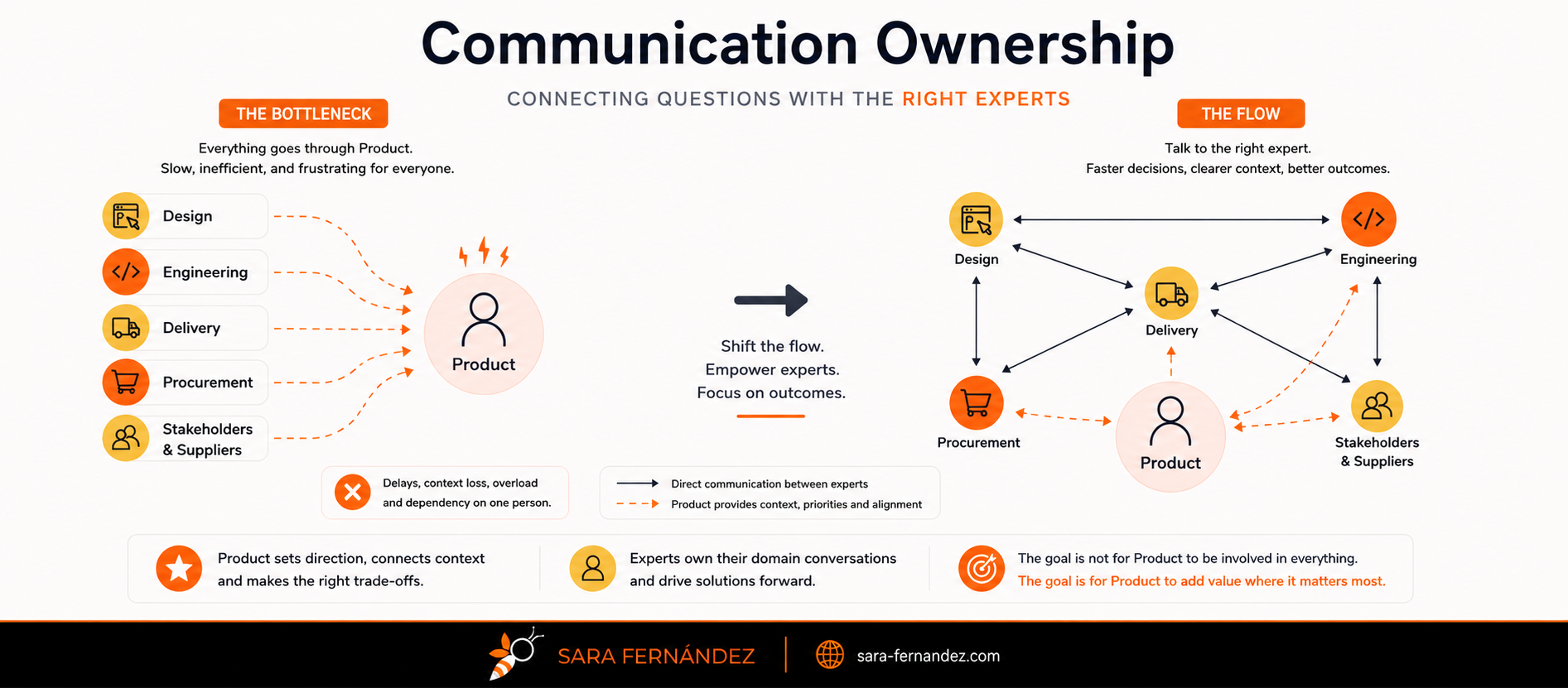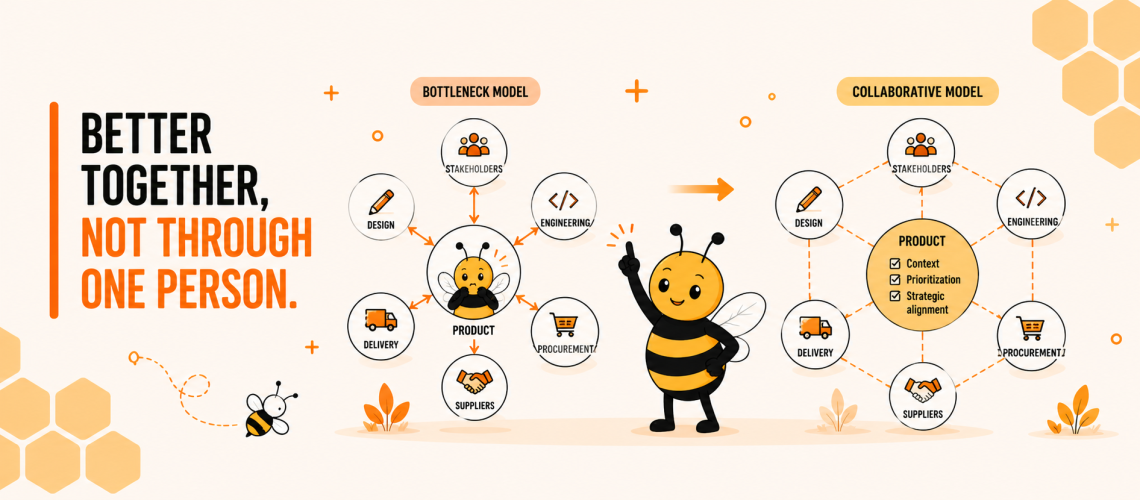

One of the biggest misconceptions about Product Management is that Product should be involved in everything: every question, every supplier conversation, every stakeholder request, every technical discussion, every design decision and every meeting where someone thinks, “Maybe Product should be there just in case.”
And I get why this happens. Product Managers usually sit at the intersection of business, users, technology and delivery. We are expected to understand the strategy, clarify priorities, explain why something matters, connect initiatives to outcomes and help teams make trade-offs when not everything can be done at once. Because of that, Product often becomes the easiest person to ask when there is uncertainty.
A stakeholder has a question? Ask Product. A supplier needs clarification? Ask Product. Design wants feedback? Ask Product. Engineering needs to understand the business impact? Ask Product. Procurement wants context? Ask Product. Someone is unsure who owns the answer? Ask Product.
At first, this may look like good coordination. Product has the context, Product knows the roadmap and Product can probably point people in the right direction. But over time, this creates a problem: Product becomes the communication hub for conversations that should be happening directly between the people who actually own the expertise. And that is where teams start to slow down.
Product Management is not a relay function
Product Management is not about forwarding messages between teams, although many organizations unintentionally push Product into that role. Of course, communication is a huge part of the job. A Product Manager who cannot communicate clearly will struggle, because we need to align stakeholders, explain priorities, provide context, document requirements, challenge assumptions and ensure that decisions are connected to business and customer outcomes. But there is a big difference between enabling communication and becoming the mandatory intermediary for every conversation.
When Product becomes the default relay, every discussion starts passing through one person. Design asks Product, Product asks Engineering, Engineering answers Product and Product goes back to Design. A supplier asks Product, Product asks the Delivery Manager, the Delivery Manager asks Engineering, Engineering replies, the Delivery Manager tells Product and Product goes back to the supplier. A stakeholder asks Product about a contractual topic, Product asks Procurement, Procurement replies and Product summarizes the answer.
This may sound organized, but it is often inefficient. Every handoff increases the chance of losing nuance, every extra step creates delay and every translation layer can change the meaning of the message. Even worse, it prevents the people with the right expertise from building the direct relationships they need to work well together. Product ends up owning the movement of information instead of helping the organization make better product decisions.
Why Product becomes the communication hub
Before blaming teams for routing everything through Product, it is important to understand why this happens. In many organizations, Product naturally becomes a central point of contact because the role touches many parts of the business. Product talks to leadership about strategy, to customers or users about problems, to Design about user experience, to Engineering about feasibility, to Delivery about planning and to Sales, Marketing, Support, Legal, Finance, Procurement and external suppliers about different aspects of the product.
From the outside, it can look like Product owns everything. But Product does not own everything. Product owns the problem space, the product direction, the prioritization logic, the expected outcomes and the clarity around what needs to be achieved. That does not mean Product owns every conversation required to make it happen.
Another reason this happens is fear of misalignment. Some organizations worry that if stakeholders, suppliers or teams communicate directly, decisions will be made without Product context. So they create a model where Product must be copied into everything or approve every interaction. The intention is good: protect alignment. The result is often the opposite: slower decisions, passive teams and overloaded Product Managers.
There is also a cultural element. In less mature organizations, people often prefer to ask the person who “knows everything” instead of identifying the person who truly owns the topic. This creates dependency on individual connectors instead of building scalable communication systems. And Product Managers, let’s be honest, can also contribute to the problem. Sometimes we stay in too many conversations because we want to be helpful, because we are afraid of missing context or because we think being involved in everything proves our value. But being busy is not the same as being effective.
Communication ownership is not the same as decision-making authority
This distinction is essential. Communication ownership defines who is best positioned to have a conversation, answer a question or move a topic forward. Decision-making authority defines who is accountable for the final decision. They are related, but they are not the same.
For example, Engineering may own the conversation about technical feasibility because engineers are best positioned to explain implementation constraints, risks and architectural options. But Product may still own the prioritization decision if the technical options require a trade-off between business value, customer impact, scope and timeline.
The same happens with Design. Design may own the conversation about user flows, accessibility, interaction patterns or visual hierarchy, while Product provides business context, clarifies the customer problem or validates whether the proposed solution supports the desired outcome. Procurement may own the conversation about contract terms, supplier onboarding or commercial conditions, while Product explains why the supplier is needed, what business problem they support and what outcomes are expected from the engagement.
A Delivery Manager may own the conversation about dependencies, planning and timeline coordination, while Product assesses whether a delivery change affects roadmap commitments, stakeholder expectations or customer value. When teams confuse communication ownership with decision authority, they often over-involve Product in conversations Product does not need to lead. A better question is not “Should Product be involved?” but “What is this conversation actually about?”
The nature of the question should determine the owner
A simple communication model can help. Instead of automatically involving Product whenever uncertainty exists, teams should identify the nature of the discussion and connect the question with the person or team best equipped to answer it. If the question is about business goals, prioritization, requirements or trade-offs, Product should usually be involved. If the question is about user needs, research, UX or design, Design or Research should usually lead. If the question is about feasibility, architecture or implementation, Engineering should be involved. If the question is about timelines, planning or dependencies, the team accountable for delivery should lead. If the question is about budget, contracts or procurement, Finance, Procurement or the budget owner should usually be the primary contact.
The source of the question matters less than the topic. It does not matter whether the question comes from an internal stakeholder, an external supplier, an agency, a consultant, a customer-facing team or a partner. What matters is who is best equipped to answer it and move the conversation forward.
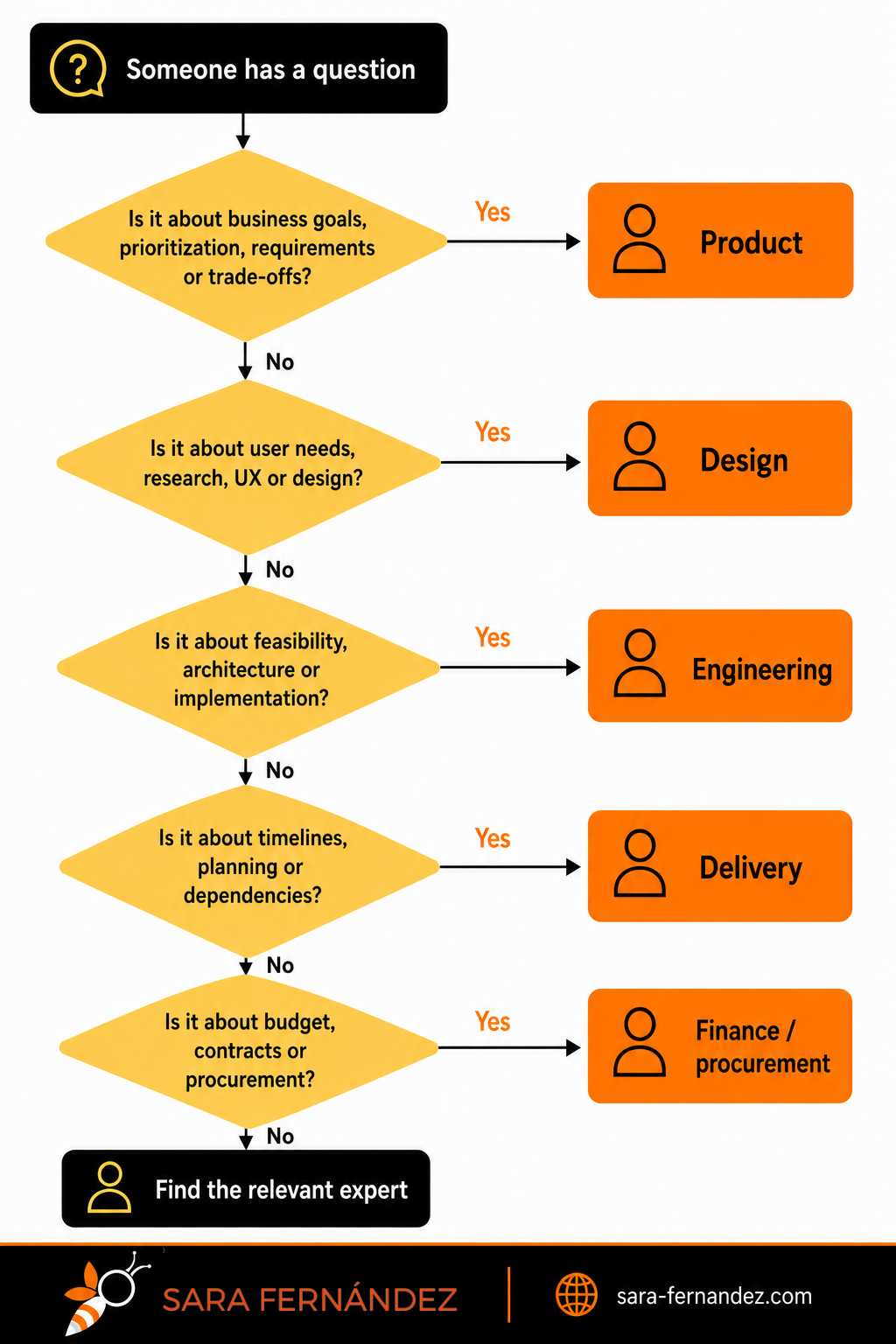
This is where a visual decision flow can be very useful. A flowchart does not need to capture every possible exception, but it can help teams pause before defaulting to Product and ask: is this a product question, a design question, a technical question, a delivery question or a commercial question? That small pause can prevent a lot of unnecessary handoffs.
Where Product should be the primary owner
This does not mean Product should step back from everything. Quite the opposite. Product should be deeply involved where Product adds the most value, especially when discussions relate to business goals, strategic context, prioritization, requirements, trade-offs, customer impact or expected outcomes.
Product should explain why something matters. What business goal are we trying to support? What customer problem are we solving? Why is this initiative important now? How does it connect to the product strategy? What outcome are we expecting? This is one of the most important responsibilities of Product Management: connecting the work of the team to the broader business and customer context. Without that context, teams may deliver outputs that are technically correct but strategically weak.
Prioritization is also a core Product responsibility. When there are multiple requests, limited capacity or conflicting expectations, Product should help determine what matters most and why. This does not mean Product prioritizes in isolation. Good prioritization depends on input from Engineering, Design, Research, Data, Sales, Support, Finance and other teams. But Product is usually accountable for making sure priorities reflect customer value, business impact, strategic direction and opportunity cost. If a supplier receives conflicting requests from multiple internal teams, if a stakeholder asks why one initiative is ahead of another or if Engineering identifies that two requirements cannot both be delivered within the same timeline, Product should be involved.
Product should also own clarity around what needs to be achieved. This includes functional requirements, expected behavior, scope, acceptance criteria, business rules and success indicators. If someone is unclear about what the product should do, Product should help clarify it. If a requirement is ambiguous, Product should refine it. If a supplier or internal team needs to understand the expected outcome, Product should provide that clarity. This is different from telling every team how to do their work. Product should clarify the “what” and “why,” while collaborating with specialists on the “how.”
Trade-offs are another area where Product often adds the most value. Should we reduce scope to meet a deadline? Should we accept a technical workaround for now or invest in a more scalable solution? Should we prioritize a customer-facing improvement over an internal efficiency gain? Should we delay a feature because research shows the problem is not validated? These decisions require business context, customer understanding and strategic judgment.
Product should not be absent from these conversations, but Product should also not make these decisions without the people who understand the implications. A technical trade-off needs Engineering. A UX trade-off needs Design. A delivery trade-off needs Delivery. A commercial trade-off may need Finance or Procurement. Product should not replace the expertise of specialists or become the spokesperson for every discipline involved in product development. Product’s role is to connect those perspectives, provide the necessary business context and ensure decisions remain aligned with customer needs and business objectives.
Product should also be involved when a conversation affects customer value, business commitments, product positioning, roadmap expectations or strategic alignment. If a delivery delay affects a customer launch, Product should know. If a technical constraint affects the user experience, Product should participate. If a supplier proposal changes the scope, Product should evaluate the impact. If a stakeholder request changes priorities, Product should be involved. Product’s role is to make sure decisions do not happen in isolation from the broader product context.
Where Product should not be the default owner
Now let’s look at the other side. There are many conversations where Product may need to be informed or consulted, but should not automatically be the primary owner. This distinction matters because over-involving Product in every domain-specific conversation does not create better alignment. In many cases, it delays the conversation and prevents the actual experts from speaking directly to each other.
If the question is about user flows, interface behavior, interaction patterns, accessibility, usability, design consistency or visual hierarchy, Design should usually lead the conversation. Product can and should provide context: what is the business goal, who is the user, what problem are we solving, what constraints do we need to consider and what priority does this have? But Product should not act as the translator between Design and everyone else. Designers should be able to discuss design directly with suppliers, stakeholders, researchers, engineers and other designers. If a supplier has a question about a user flow, they should not need Product to repeat the question to Design. If Engineering needs to understand why a design pattern was chosen, they should be able to talk directly to Design. Product can join when business context, prioritization or trade-offs are needed, but Product should not become the owner of every design conversation.
The same logic applies to user research. Product should help define research goals, expected learning outcomes and key business questions, but Research or Design should usually own research methodology, execution, recruitment approach, interview structure, usability testing and synthesis of findings. Product should be involved in interpreting what the research means for the product strategy, but Product does not need to be the primary contact for every operational research question. This is especially important because research quality depends on expertise. If Product becomes the communication layer between researchers and everyone else, nuance can be lost.
Technical feasibility and implementation are another common area where Product is overused as an intermediary. Engineering should lead conversations about technical feasibility, architecture, dependencies, implementation options, performance, security, scalability and technical risk. Product should not be expected to explain technical constraints on behalf of Engineering unless the discussion has already been translated into product impact. If a supplier proposes a technical solution, Engineering should evaluate it directly. If a stakeholder wants to understand why a certain implementation is complex, Engineering should explain it. If there is a question about system behavior, data flow or architecture, Engineering should be involved.
Product should participate when technical options create business trade-offs. Can we reduce scope? Is the extra effort worth the value? Should this be part of the current release or a later iteration? Does the technical decision affect customer experience or business outcomes? That is where Product adds value.
Delivery conversations are also often mistakenly routed through Product. Delivery planning, dependency tracking, timeline coordination and resource management should usually sit with the team accountable for delivery, whether that is a Project Manager, Delivery Manager, Engineering Manager, Product Operations role or delivery lead. Product should understand the delivery plan and challenge it when needed. Product should also assess business impact when timelines shift. But Product should not become the single point of contact for every planning update, dependency question or delivery coordination activity. Otherwise, Product ends up spending more time managing timelines than managing product outcomes.
Finally, commercial conversations should involve the right commercial owners. If the topic is budget approval, contract terms, supplier onboarding, purchase orders, legal clauses, invoicing or procurement processes, Product should not be the primary owner unless Product also owns the budget or commercial relationship. Product may provide context, such as why the supplier is needed, what value the work will create, what outcome we are trying to achieve or what happens if we do not move forward. But Procurement, Finance, Legal or the budget owner should lead the commercial discussion. This is especially important with external suppliers. Product may be responsible for the product outcome, but that does not automatically make Product responsible for every contractual or administrative interaction.
Internal stakeholders and external suppliers should follow the same logic
Many organizations treat supplier communication differently from internal communication. Internally, teams may speak directly to each other, but when an external supplier is involved, everything suddenly goes through Product. This often happens because organizations want to control the message, protect context or avoid confusion. Again, the intention is understandable, but if every supplier question must go through Product, the same bottlenecks appear.
A design supplier asking about UX details should be able to speak directly with Design. A technical partner working on an integration should be able to speak directly with Engineering. An agency supporting research should be able to speak directly with Research or Design. A vendor discussing delivery risks should be able to speak with the person accountable for planning. A supplier discussing contracts should speak with Procurement or the budget owner.
Product should remain involved where business context, prioritization, requirements, scope or strategic alignment are needed. The principle is the same for internal and external communication: the topic determines the communication owner, not the fact that the person asking is external.
Common scenarios and who should lead them
Frameworks are useful, but examples make them easier to apply. In real organizations, communication ownership is not always obvious because many conversations sit between disciplines. A question may start as a design clarification and quickly become a prioritization discussion. A technical constraint may trigger a scope decision. A delivery risk may affect business commitments. That is why the goal is not to create rigid rules, but to help teams identify who should lead the conversation and when Product should be involved.
Scenario 1: A supplier has a question about a user flow
A design supplier is reviewing a proposed flow and wants feedback on alternative approaches. The primary contact should be Design, because Design is best positioned to discuss user experience, interaction patterns, usability considerations and design standards. Product should join if the discussion requires business context, prioritization or clarification of the customer problem.
Product does not need to collect the supplier’s question, send it to Design, wait for an answer and then summarize it back to the supplier. That adds delay and increases the risk of losing important context. A more effective model is to let the supplier and Design speak directly, while Product remains available if the conversation moves into business priorities or product direction.
Scenario 2: A stakeholder wants to know why one initiative is prioritized over another
In this case, the primary contact should be Product because this is a prioritization conversation. Product should explain the business context, customer problem, expected outcome, strategic importance and relative priority of the initiative.
Other teams may provide input, but Product should own the prioritization logic. This does not mean Product has to defend decisions alone or ignore other perspectives. It means Product is responsible for explaining how the decision connects to business goals, customer value and product strategy.
Scenario 3: Engineering identifies a technical constraint
Engineering discovers that a proposed feature is more complex than expected and may require additional time or scope reduction. The primary conversation should start with Engineering explaining the constraint clearly, because Engineering owns the technical explanation. Product should then be involved to assess the trade-off.
Should scope change? Should the timeline move? Should the feature be split? Is the business value still worth the effort? Engineering owns the technical context, while Product owns the business trade-off. Both are needed because a good decision requires both perspectives.
Scenario 4: A requirement is unclear
A supplier or team member does not understand the expected behavior of a feature. In this case, the primary contact should be Product because requirements clarity is a Product responsibility. Product should explain the expected behavior, success criteria, business rule or acceptance criteria.
If the ambiguity is caused by a technical constraint, Engineering may need to join. If the ambiguity affects the experience, Design may need to join. But Product should own the clarification of what outcome is expected and make sure everyone understands the requirement in the same way.
Scenario 5: A delivery date is at risk
A team identifies that a dependency may delay an agreed delivery date. The primary contact should be the person or team accountable for delivery planning, because they are best positioned to explain the plan, dependencies, constraints and risks.
Product should be informed and involved if the change affects business commitments, roadmap expectations, customer communication or prioritization. Product has a legitimate role in challenging timelines when business priorities require it, but Product should not automatically become the owner of every delivery coordination conversation.
Scenario 6: A supplier receives conflicting requests from different teams
A supplier is getting input from Design, Engineering and Marketing, but the requests conflict. In this case, the primary contact should be Product because this is a prioritization and alignment issue. Product should clarify what matters most based on business objectives, customer value and strategic priorities.
This does not mean Product should ignore the input from other teams. It means Product should help resolve the conflict and provide direction. When multiple valid perspectives compete, Product’s role is to help the team understand the trade-offs and align around the most valuable outcome.
Scenario 7: Research findings challenge the current roadmap
Research reveals that a planned feature may not solve the user problem as expected. This conversation should involve Research, Design and Product because each team brings a different type of expertise. Research owns the evidence, Design may help interpret experience implications and Product owns the impact on strategy, prioritization and roadmap decisions.
This is a good example of why communication ownership is not always one person. Some conversations require multiple experts, but each person should be there for a clear reason. The important thing is not that Product controls the conversation, but that the right expertise is present when the decision needs to be made.
Scenario 8: A stakeholder asks for a feature because “a client needs it”
The primary contact should be Product because this is not just a request intake conversation. It requires discovery. Product should understand the underlying problem, evaluate whether the request aligns with strategy, assess customer value and determine priority.
Sales, Support or Customer Success may provide important context. Engineering may later assess feasibility. Design may explore the experience. But Product should own the product evaluation and avoid turning every request into an automatic commitment.
Scenario 9: Procurement needs information for a supplier contract
The primary contact depends on the question. If Procurement needs business justification, Product can provide context. If Procurement needs scope of work details, Product may contribute requirements and outcomes. But if Procurement needs contract terms, pricing, legal clauses or supplier onboarding information, Procurement, Finance or Legal should lead.
Product should support the process, not become the commercial owner by default. This distinction is important because supplier relationships often involve product outcomes, but they also involve legal, financial and administrative responsibilities that sit outside Product’s core role.
Scenario 10: A senior stakeholder questions the timeline
The primary contact should usually be Delivery or the accountable delivery lead, with Product involved. Delivery should explain the plan, dependencies and risks, while Product should explain business priorities, scope decisions and impact.
This is another shared conversation. Product should not be left alone to defend a timeline if the timeline is based on delivery constraints. But Product should also not be absent if the timeline affects roadmap expectations, stakeholder commitments or customer outcomes.
Scenario 11: Marketing wants to understand positioning for an upcoming launch
The primary contact should be Product, often together with Marketing. Product should explain the customer problem, value proposition, target audience, differentiation and expected outcome. Marketing owns how that message is translated into campaigns and go-to-market activities.
Product should provide the product context, while Marketing should own the marketing execution. The conversation works best when both teams collaborate directly instead of one trying to absorb the responsibilities of the other.
Scenario 12: Support reports repeated customer confusion
The primary contact should be Product, but the conversation may quickly involve Design, Research or Engineering. Support is bringing valuable customer insight, so Product should assess whether the issue reflects a product gap, usability problem, communication issue or prioritization opportunity.
If the problem is UX-related, Design should join. If it is caused by system behavior, Engineering should join. If more evidence is needed, Research or Data may join. Product should help connect the signal to the right action, not try to solve every dimension of the problem alone.
The cost of making Product the default intermediary
When Product becomes the mandatory communication layer, the damage is not always immediate. It often builds slowly. At first, it feels manageable. Then the number of conversations grows: more stakeholders, more suppliers, more meetings, more Slack messages, more requests for “quick context” and more situations where people say, “Can you check with them and let us know?” Eventually, Product spends too much time moving information around and too little time doing actual product work.
The first cost is slower decision-making. Every extra handoff adds time. When the person asking the question cannot speak directly with the person who knows the answer, the conversation becomes slower by design. This is especially damaging when teams are working through complex topics that require back-and-forth discussion. A design question may need exploration, a technical question may need clarification and a delivery risk may need immediate coordination. Routing everything through Product turns a conversation into a queue.
The second cost is context loss. Product Managers are good at connecting context, but we are not perfect translation machines. When we relay conversations between specialists, nuance gets lost. A technical concern may become oversimplified, a design rationale may lose important user context, a supplier constraint may be misunderstood or a stakeholder concern may be reduced to a vague summary. Direct communication preserves the original context and allows people to ask follow-up questions in real time.
The third cost is reduced accountability. When every conversation goes through Product, other teams may unintentionally step back from ownership. Design may wait for Product to communicate design feedback. Engineering may wait for Product to explain technical trade-offs. Delivery may wait for Product to escalate timeline risks. Stakeholders may wait for Product to chase answers. This creates a culture where Product becomes responsible for moving every topic forward, even when Product is not the right owner. Healthy teams do not work that way. Healthy teams know who owns what and communicate accordingly.
Another cost is that Product becomes increasingly reactive. A Product Manager who is constantly relaying information has less time for discovery, strategy, prioritization, stakeholder alignment and outcome measurement. Instead of asking what problem should we solve next, what customer behavior are we trying to change, what opportunity are we missing or what trade-offs should we make, Product spends the day asking who needs to answer this, who should I forward this to, did they reply, can I summarize this clearly and who needs to be copied. That is not Product Management. That is communication administration.
Finally, making Product the default intermediary creates unnecessary dependency. If everyone depends on Product to connect them, the organization becomes fragile. What happens when the Product Manager is on vacation? What happens when the Product Manager is overloaded? What happens when the number of teams, suppliers or stakeholders grows? A scalable product organization cannot rely on one person being the bridge for every interaction. It needs clear ownership and direct collaboration.
What Product should do instead
If Product should not be the communication hub for everything, what should Product do? The answer is not to disappear from conversations. The answer is to design better communication paths so that the right people can collaborate directly while Product remains involved where business context, prioritization, scope or strategic alignment are needed.
The first step is to clarify ownership upfront. For every initiative, Product can help define who owns which type of conversation. Product owns business context, prioritization, requirements and trade-offs. Design owns UX, research execution and design decisions. Engineering owns feasibility, architecture and implementation. Delivery owns planning, dependencies and timeline coordination. Procurement owns contracts, supplier onboarding and commercial processes. This can be documented in a simple table, decision flow or working agreement. The goal is not bureaucracy. The goal is clarity.
Product can also set expectations with stakeholders and suppliers. For example: “For questions about requirements or priorities, come to Product. For UX and design decisions, please work directly with Design. For technical feasibility, Engineering should be involved directly. For planning and dependencies, Delivery will be the primary contact. For commercial topics, Procurement owns the conversation.” This helps stakeholders and suppliers understand that Product is not refusing involvement. Product is making sure each topic reaches the right expert.
At the same time, Product should stay involved where alignment is needed. Direct communication does not mean uncontrolled communication. Teams can speak directly while still keeping Product informed when needed. Design and Engineering can discuss implementation details directly, then involve Product if the decision affects scope or user value. Procurement and a supplier can discuss contract terms directly, then involve Product if the scope of work changes. Delivery can coordinate dependencies directly, then involve Product if the roadmap is impacted. This is how mature collaboration works.
It is also helpful to create lightweight escalation rules. Not every conversation needs Product, but teams should know when to bring Product in. Product should be involved when a decision affects customer value, a change affects scope, a trade-off is required, a timeline shift affects business commitments, a requirement is unclear, priorities conflict, a decision affects the roadmap or there is a risk to the expected outcome. This creates a clear threshold for involvement without requiring Product to be present in every conversation by default.
Finally, Product should encourage direct relationships between experts. Designers should know who to talk to in Engineering. Engineers should know who to talk to in Design. Suppliers should know who owns which topic. Stakeholders should understand which questions belong to Product and which belong elsewhere. Product can help create these connections, but should not permanently sit between them. A good Product Manager does not make themselves the center of every conversation. A good Product Manager helps the right conversations happen without unnecessary friction.
How this communication model improves Product Management
This communication model is not only better for teams. It is better for Product. When Product is not overwhelmed by unnecessary relay work, Product can focus on higher-value responsibilities: discovery, strategy, understanding customers, prioritization, measuring outcomes, improving requirements, aligning stakeholders and identifying risks before they become problems.
Product becomes more effective because Product is involved where Product is actually needed. This also improves the quality of decisions. When Engineering explains technical constraints directly, decisions are better informed. When Design explains UX rationale directly, stakeholders understand the experience better. When Delivery explains planning risks directly, timelines are more realistic. When Procurement handles commercial topics directly, contracts move faster. And when Product provides context at the right moments, the team remains aligned around business and customer outcomes.
The result is not less collaboration. It is better collaboration. Product is no longer acting as a communication router, but as a strategic connector that helps teams understand the business and customer impact of their decisions.
What mature Product organizations do differently
A mature Product organization is not one where Product is copied into every conversation. It is one where communication ownership is clear, subject matter experts talk directly to each other and Product provides strategic alignment when it is needed.
In mature organizations, teams understand when Product needs to be involved. Stakeholders know where to go for answers. Suppliers are connected to the people best equipped to help them. Decisions are made with the right expertise in the room. There is less dependency on individual intermediaries and more trust in team ownership.
This does not reduce Product’s importance. It makes Product’s role clearer. Product is not valuable because everything passes through Product. Product is valuable because it helps the organization make better decisions about what to build, why it matters and how to create customer and business value.
A practical way to start
If your team currently routes most communication through Product, changing that model does not require a huge transformation. Start small. Look at the last ten questions Product received and ask: was Product the right primary owner? Was Product needed for context only? Could this question have gone directly to Design, Engineering, Delivery, Procurement or another expert? Was Product involved because the topic required Product expertise or because people did not know who else to ask?
Then create a simple communication ownership guide. It does not need to be perfect. It can be as simple as: if the question is about priorities, requirements or business trade-offs, contact Product. If the question is about UX, research or design decisions, contact Design. If the question is about feasibility, architecture or implementation, contact Engineering. If the question is about timelines, planning or dependencies, contact Delivery. If the question is about contracts, budget or procurement, contact Procurement, Finance or the budget owner. If none of these apply, identify the relevant subject matter expert.
The important part is not the document itself. The important part is the shared understanding it creates. Once people know where to go for each type of conversation, Product can stop being the automatic entry point for everything and start focusing on the conversations where Product adds the most value.
Final thoughts
Product Management is a communication-heavy role, but that does not mean Product should own every conversation. There is a difference between being strategically involved and being operationally inserted into everything. The goal is not to exclude Product, but to involve Product where Product adds the most value: business context, prioritization, requirements, trade-offs, customer impact and strategic alignment.
For everything else, the best communication path is usually the most direct one. Design questions should reach Design. Technical questions should reach Engineering. Delivery questions should reach the people accountable for delivery. Commercial questions should reach Procurement, Finance or the budget owner. And Product should help ensure those conversations remain aligned with customer needs and business goals.
A strong Product organization does not depend on Product Managers acting as communication routers. It depends on clear ownership, direct collaboration and the confidence that the right experts can talk to each other. Because the goal is not for Product to be involved in everything. The goal is for Product to add value where it matters most.